

Fishing port of Camaret
Fishing port and marina
No fish market but fish preparation area 7 fixed vessels (small-scale coastal fishing)

Fishing port and marina
Presence of a fish market, online sales only Flotilla of 30 vessels (gillnetter and trollers)
![]()
• Port waste collection centre closed
• 2 bins on the docks for cardboard and plastic
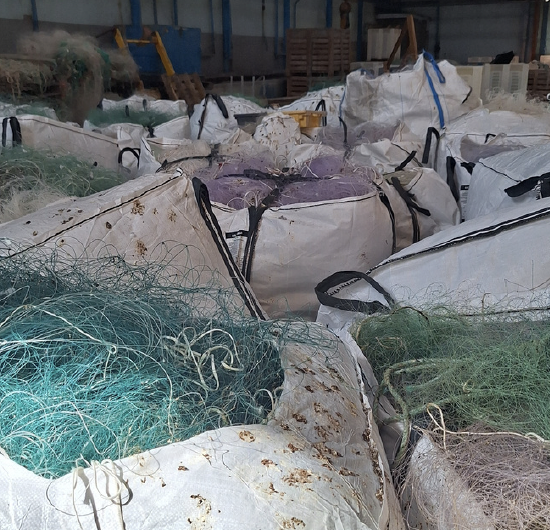
• Storage space in a closed shed for used nylon nets stored in 1m3 big bags and a 30m3 CIW skip
• Forklift for transporting nets for all fishermen with a certificate of ability to drive this type of vehicle.
Filet Recyclage collects used nets, which are then sorted, packaged and sent for granulation to companies, mainly in Europe. These pellets are used to make nylon objects.
• Fishermen put their used fishing nets directly into the big bags (no dedicated staff).
• The nets are collected by the company Filet Recyclage for recycling 3 times a year.
• The fish market manager is responsible for waste management.
Management costs: 562€ (2023) Quantity: 13.83T (2023)
![]()
Fishermen bring the litter they collect while fishing back to the port.
Disposal in a CIW skip without quantification or qualification.
![]()
• The port is responsible for purchasing the big bags, which represents a high cost.
• Loading the lorry carrying the big bags of nets takes a long time (1/2 day).
• It is sometimes difficult to raise awareness among fishermen about sorting their nets.
• Combating illegal dumping with enclosed areas and cameras.
• A long tradition of assembling and dismantling of nylon nets by fishermen in an enclosed, sheltered and easily accessible warehouse.
• Free access to a forklift to transport the nets from the docks to the warehouse.
• Monitoring of the quantities of nets collected in a file shared with the CCI.
Objectives:
Obtain the Clean Harbours Label: construction work to relocate the careening area and redevelop the space in front of the waste collection centre.

Fishing port and marina
No fish market but fish preparation area 7 fixed vessels (small-scale coastal fishing)

General cargo (paper, wood, fruit, steel), bulk solids (grains, flours, and fertilizers), ship services (construction, repair, fuel, oils…), fishing activity (fresh and frozen), fish auction.
Fishing practice: 77 vessels and ships (mainly inshore, 12 trawlers operating in the Grand Sole fishing grounds, 4 coastal trawlers, and 8 operating in Portuguese waters)
Landings: Sardine, horse mackerel, Atlantic mackerel, Atlantic bonito, spider crab, velvet crab, shrimp, Norway lobster, hake, European hake (whiting), blue whiting, squid, monkfish, scorpionfish, red gurnard, sole, cuttlefish, octopus, conger eel, ray, others

Fishing activity and fish market.
Fishing practice: fleet of 144 vessels and ships (mostly small-scale fishing vessels)

Fishing port, marina & ship repair area Presence of a fish market
Flotilla of 98 vessels (mostly deep-sea)

Fishing, seafood processing and sales.
Marine leisure cruises, sailing club, tourism.
Fishing practice: There are currently 5 pelagic trawlers, 36 demersal trawlers and 12 crabbers.
Landings: Prawn, Crab and white fish

Fishing port, commercial port and marina. Presence of a fish market Flotilla of 55 fishing vessels :
mainly dredgers & caseyeur (pot vessels)

General cargo, bulk solids, ship service, fishing activity (fresh and frozen), fish market.
Fishing practice: fleet of 359 vessels and ships (mostly artisanal vessels)
Landings: Black monkfish, White monkfish, Blue shark, Swordfish, Northern megrim, Atlantic pomfret, European hake, Korean flounder, Common squid, Horse mackerel…

Fishing port, commercial port and marina Presence of a fish market
Flotilla of 40 fishing vessels (mainly coastal fishing) 1500 deep-sea trawlers landing fish every year.

This is a multi-purpose port which accommodates approx.
20 trawlers, 5 scallop boats and 25 inshore vessels for crab, lobster & whelk. In addition, charter deep-sea angling vessels, tourboats to the Saltee Islands, and leisure crafts use the port.
There are also seafood processing plants next to the port.