information sheet
Fishing port of Le Guilvinec
Fishing port, marina & ship repair area Presence of a fish market
Flotilla of 98 vessels (mostly deep-sea)

Fishing port and marina
Presence of a fish market
Flotilla of 95 fishing vessels (trawlers, trollers, pot vessels gillnetter)

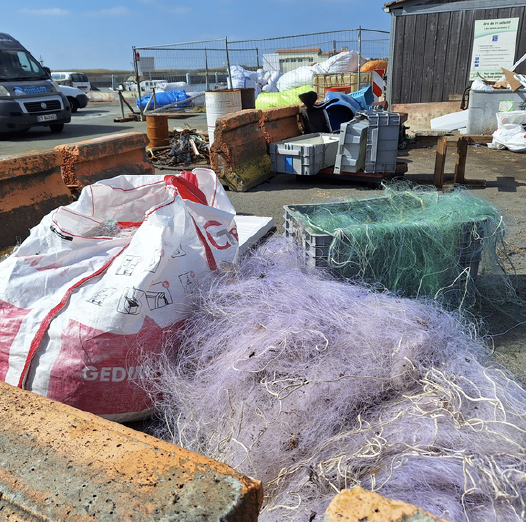
• 6 skips on the docks for EOLFG (nets and ropes)
• Closed port waste collection centre for the management of CIW and hazardous waste.
• Collection and recycling of nets by Fil&Fab to recover the raw material.
• Experiment conducted by Fil&Fab and WWF: recovery of 3 tonnes of trawl nets in May 2024
(shredding and recycling tests).
• FILIPECH project in 2022: 2 tonnes of trawl nets sent to Plastix (Denmark) for recycling.
• Fishermen put their used fishing nets and gear directly into the skips.
• There are 2 social work structures in the port: ‘L’Atelier des gens de mer’ (managing the waste collection centre) and the ESAT ‘Claires et mer’ (dismantling nets).
• Management costs: included in the port user fee.
• All waste costs the port at least €100,000 per year.
• Quantity: 6T of nets in 2024 / 10T of used trawls / year.
Fishermen bring the passively fished waste back to the port (green bags supplied by ReSeaclon and bins on the quayside). Test operation by ReSeaclons carried out with 4 to 5 boats in order to quantify and qualify the waste passively fished.
Waste passively fished increases the cost of waste paid by the port. Fishermen do not sort waste which is an obstacle to recovery.
• Constant increase in the cost of waste management.
• Trawls stored on docks awaiting recycling solution.
• Active involvement of the harbour in the management of port waste (waste reception plan dated 2023).
• Closed waste collection centre (to prevent illegal dumping).
• Diagnostic carried out in 2021 to identify ways of improving waste management and raise awareness among port users.
• Long tradition of management and recycling of nylon nets via the presence of 2 disabled employment structures in the port.
• A tripartite agreement between the port, the Atelier des gens de mer and Fil&Fab for the recycling of nets implemented in 2024.
• Objectives:
o Set up a recycling scheme for trawl nets.
o Improve port users’ compliance with waste regulations.
o Increase awareness of waste issues among port users.
Fishing port, marina & ship repair area Presence of a fish market
Flotilla of 98 vessels (mostly deep-sea)
A busy port that is home to several state organisations and fishing businesses. Including a seafood processing plant, an ice plant, fisherman’s co-op, and shipping agents. Cruise liners and island ferries also dock here.
30 x >20m fishing vessels are based at the port, the majority are whitefish trawlers.
Multiple port activities, highlighting liquid and solid bulk traffic, as well as general cargo. Fishing is the main pillar of the port and has a fish market.
Fishing practice: 94 vessels (mostly small-scale), but the number rises to 190 when including boats that unload at the fish market but are not based at the port.
Landings: Poor cod, horse mackerel, mackerel, sardine, common bream, European anchovy, starling, hake, whiting, sole, megrim, skate, dogfish, black scorpionfish, monkfish, John Dory, red mullet, rockling, pollock, pipefish…
Fishing port and marina
Presence of a fish market, online sales only Flotilla of 30 vessels (gillnetter and trollers)
A busy fishing harbour, home to a sailing club food shop/ smoke house, seafood shop, adventure facility, sailing club, coast guard, tour operators, boat yard, RNLI Lifeboat, net mending facility and a BIM ice plant.
Fishing practice: 12 regular boats under 24m,
Mostly bottom trawls, 1 x beamer trawl, 2 x pure seines Landings: White fish – Hake, Haddock, Whiting
Commercial, nautical-sport, tourism, fishing, and shipyard activities, fish market.
Fishing practice: for WIF, three trawlers from the Mares Circulares project (with lengths ranging from 28 to 36 meters) are collaborating
Landings: Atlantic mackerel, European anchovy, and Atlantic bonito
General cargo, bulk solids, ship service, fishing activity (fresh and frozen), fish market.
Fishing practice: fleet of 359 vessels and ships (mostly artisanal vessels)
Landings: Black monkfish, White monkfish, Blue shark, Swordfish, Northern megrim, Atlantic pomfret, European hake, Korean flounder, Common squid, Horse mackerel…
Fishing, seafood processing and sales.
Marine leisure cruises, sailing club, tourism.
Fishing practice: There are currently 5 pelagic trawlers, 36 demersal trawlers and 12 crabbers.
Landings: Prawn, Crab and white fish
Fishing port, commercial port and marina. Presence of a fish market Flotilla of 55 fishing vessels :
mainly dredgers & caseyeur (pot vessels)