
Welcome
to the website dedicated to preventing waste in fishing ports on the Atlantic coast
As part of the Free-LitterAT project, several European partners (France, Spain, Portugal, Ireland) are working together to tackle marine litter. One of the key priorities is to reduce waste from used fishing gear and waste passively fished by encouraging its collection, treatment and recycling.
Find out more about current practices in fishing ports on the Atlantic coast and the solutions that can be implemented to limit the impact of this waste on the oceans.
Recycling
of used fishing gears
nets, trawls, traps, dredges, lines, seines, etc.
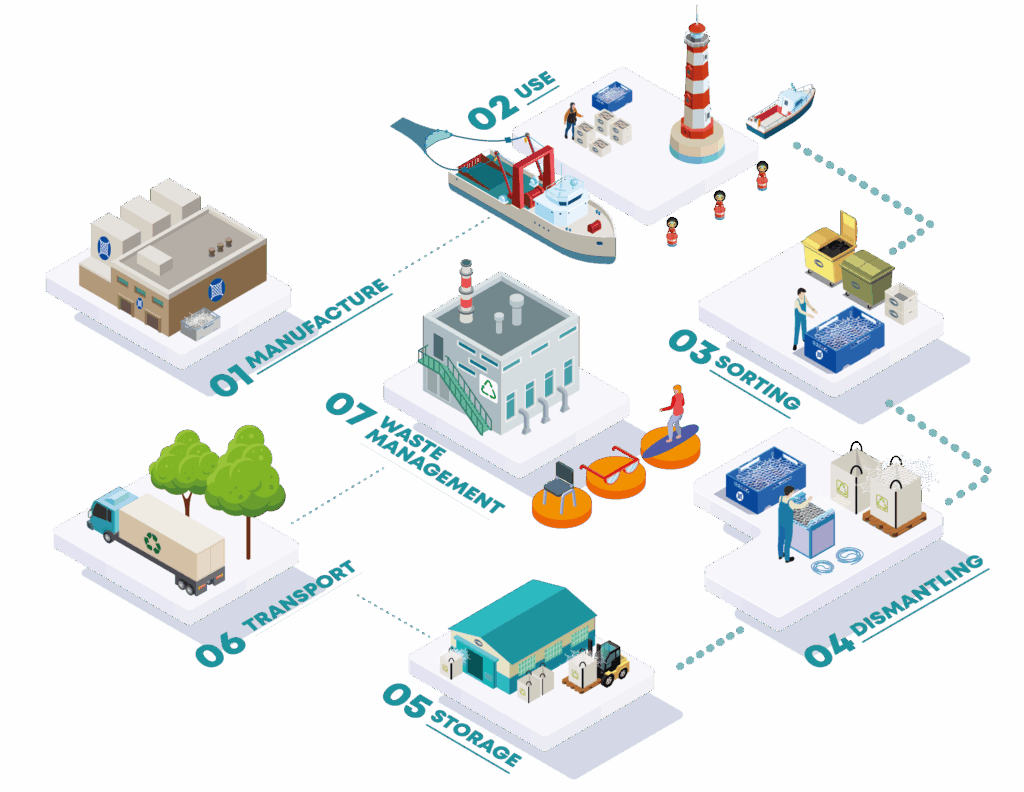
1. MANUFACTURING
• Fishing gear producers: manufactures, sells or imports fishing gear
2. USE
• Fishermen (“sailors” or “skippers”) who work on trawlers, gillnetters, line boats, pot boats…
3. SORTING
• Fishermen
• Port agents
4. DISMANTLING
• Companies specialising in the assembly and dismantling of fishing nets
• Fishermen
• Retired fishermen
• Adapted employment services
5. STORAGE
Storage facilities provided by the port manager:
• On the quayside
• In a port reception facility
• In a dedicated warehouse
6. TRANSPORT
• By the port agents themselves
• By a transport service provider
7. WASTE MANAGEMENT
• Recycling: mechanical or chemical recycling and manufacture of new objects from used fishing gear.
• Other types of waste management: Incineration, Landfill, Energy recovery.
Today, the majority of used fishing gear ends up in landfill.
• Other existing practices: Repair, reuse, repurposing, etc.

Create zero-waste coastal communities by combining knowledge,
tools and technologies with pilot actions involving the participation of multiple stakeholders.
Maritime identity cards


Fishing port sheets
information sheet

Fishing port of Port-en-Bessin
Fishing port
A fish market (1st auction in Normandy and 6th in France) Fleet of 61 vessels (mainly trawlers)
information sheet

Fishing port of Howth
Fishing, seafood processing and sales.
Marine leisure cruises, sailing club, tourism.
Fishing practice: There are currently 5 pelagic trawlers, 36 demersal trawlers and 12 crabbers.
Landings: Prawn, Crab and white fish
information sheet
Fishing port of Le Guilvinec
Fishing port, marina & ship repair area Presence of a fish market
Flotilla of 98 vessels (mostly deep-sea)
information sheet
Fishing port of Vigo
General cargo, bulk solids, ship service, fishing activity (fresh and frozen), fish market.
Fishing practice: fleet of 359 vessels and ships (mostly artisanal vessels)
Landings: Black monkfish, White monkfish, Blue shark, Swordfish, Northern megrim, Atlantic pomfret, European hake, Korean flounder, Common squid, Horse mackerel…
initiatives
initiative(s)
Repêchons les Océans
Founded in Spain in 2015, the international network Upcycling the Oceans transforms marine waste into resources through innovation and the circular economy.
Read moreinitiative(s)
SAO Textile
SAO is a French mission-driven company founded in February 2023. It is dedicated to recycling used fishing nets into eco-friendly textiles.
Read more