
information sheet
Fishing port of La Cotinière
Fishing port and marina
Presence of a fish market
Flotilla of 95 fishing vessels (trawlers, trollers, pot vessels gillnetter)

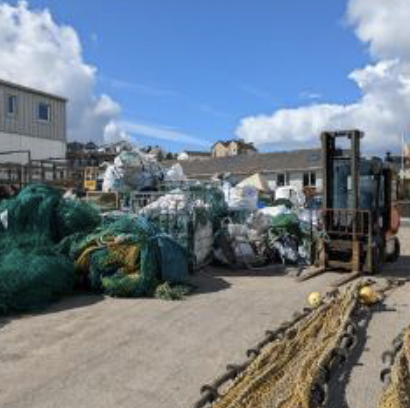
A busy fishing harbour, home to a sailing club food shop/ smoke house, seafood shop, adventure facility, sailing club, coast guard, tour operators, boat yard, RNLI Lifeboat, net mending facility and a BIM ice plant.
Fishing practice: 12 regular boats under 24m,
Mostly bottom trawls, 1 x beamer trawl, 2 x pure seines Landings: White fish – Hake, Haddock, Whiting

Delivery: Notification procedures: Fishing vessels message the HM(Habour Master) prior to arrival. The Waste disposal area is clearly marked with signage in place. Access is gained via Harbour Staff. General Waste and recycling waste is deposited by port users directly into wheelie bins located on-site. Discarded nets are given separately to the harbour staff as they damage bin lorries. Ship-Generated Waste: The harbour management arranges collections of ropes, netting, fish boxes and other ship-generated waste in a 14CY skip by Starrus Eco Holdings T/A Greenstar. There is a forklift & teleporter for use on the harbour.
Recording fishing related waste delivered by ships: A waste management spreadsheet containing details of types/quantities of waste is updated, maintained and saved in the SFAD folder. Receipts are electronic and kept for a minimum of 3 years for all waste as per S.I No.117, 2003
Pre-treatment : non- available.
Type of Waste collected that has a recovery system: General recycling, paper, cardboard, plastics, glass., Waste Oil, Metal and Rubber is reused.
Fishing gear: Nets and rope end up in the general waste stream as there is currently no recovery system for them. There is an enclosed PRF. There is a dedicated area (not enclosed) for storing nets not in use, some of these nets are potentially at their EOL. Harbour Master’s budget from DAFM, funded by the rates and charges order 2012 paid by fishermen.
• When landed ashore waste goes into designated FfL tonne bags on the port. Then it is recorded by weight and this information goes to BIM. • Some characterisation surveys have been carried out by BIM in the past. • Waste is then emptied into a designated FfL skip which goes to general waste once full. • In 2023 – 12.9 tonne of PFW was collected
Recording waste: A waste management spreadsheet containing details of types and quantities of waste maintained by the Harbour Master and saved in the SFAD shared folder.
Characterisation studies of PFW has been carried out by BIM to monitor common waste types.
Communications: Harbour Master > Fishermen – WhatsApp update on waste management/ Face to Face/ Notice board
Objectives
The harbour management would like more space to segregate fishing gear and to store items when segregated. To find a positive value chain for waste fishing gear
Fishing port and marina
Presence of a fish market
Flotilla of 95 fishing vessels (trawlers, trollers, pot vessels gillnetter)
Fishing port and marina
No fish market but fish preparation area 7 fixed vessels (small-scale coastal fishing)

Commercial, nautical-sport, tourism, fishing, and shipyard activities, fish market.
Fishing practice: for WIF, three trawlers from the Mares Circulares project (with lengths ranging from 28 to 36 meters) are collaborating
Landings: Atlantic mackerel, European anchovy, and Atlantic bonito
Fishing port and marina
Presence of a fish market, online sales only Flotilla of 30 vessels (gillnetter and trollers)
General cargo, bulk solids, ship service, fishing activity (fresh and frozen), fish market.
Fishing practice: fleet of 359 vessels and ships (mostly artisanal vessels)
Landings: Black monkfish, White monkfish, Blue shark, Swordfish, Northern megrim, Atlantic pomfret, European hake, Korean flounder, Common squid, Horse mackerel…
Fishing port
A fish market (1st auction in Normandy and 6th in France) Fleet of 61 vessels (mainly trawlers)

This is a multi-purpose port which accommodates approx.
20 trawlers, 5 scallop boats and 25 inshore vessels for crab, lobster & whelk. In addition, charter deep-sea angling vessels, tourboats to the Saltee Islands, and leisure crafts use the port.
There are also seafood processing plants next to the port.
Fishing port, marina & ship repair area Presence of a fish market
Flotilla of 98 vessels (mostly deep-sea)
A busy port that is home to several state organisations and fishing businesses. Including a seafood processing plant, an ice plant, fisherman’s co-op, and shipping agents. Cruise liners and island ferries also dock here.
30 x >20m fishing vessels are based at the port, the majority are whitefish trawlers.