information sheet
Fishing port of Port-en-Bessin
Fishing port
A fish market (1st auction in Normandy and 6th in France) Fleet of 61 vessels (mainly trawlers)

Fishing port, commercial port and marina. Presence of a fish market Flotilla of 55 fishing vessels :
mainly dredgers & caseyeur (pot vessels)

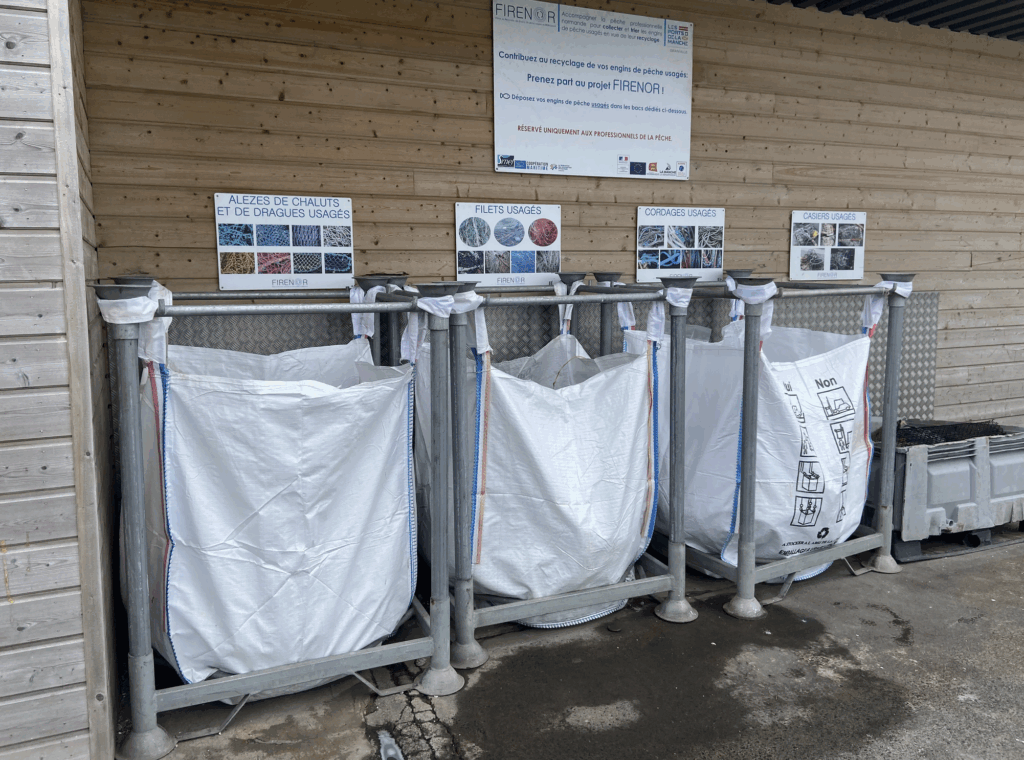
3 Big Bags of 1m3 & 1 crate behind the fish auction hall for : trawl and dredge netting / nets / ropes / used traps & pots.
• VALNET project (2023-2024): reuse of used fishing gear by incorporating their fibres to create eco-responsible fibre-reinforced concrete.
• Experiment conducted by Fil&Fab and WWF: trawl nets recycling (shredding tests planned for 2024).
• Local reuse initiatives:
o Reuse of trawls by recreational fishermen to make pots for their fishing activities.
o Recycled by second-hand shops to create new objects.
o Pochons’ project: recycling oyster bags to design bags
• One sorting area and one dedicated staff member
• EOLFG placed in Big Bags by category for transport to the dedicated reuse channels
Management costs: no data Quantity: 1,964 T in 2022 (FINEOR project)
Fishermen bring the litter they collect while fishing back to the port. Disposal in waste bins without quantification or qualification.
Installation of Big Bags to collect only passively fished litter in order to quantify and qualify the streams of waste brought back to the port.
• Recycling of certain EOLFGs is complicated, especially when material are mixed (e.g. rock hopper, dredge netting…).
• No sorting equipment, which is currently done on the ground.
• Sorting station is far away, which makes sorting less efficient.
• Recycling channels still almost non-existent.
• Net cuttings that may fall into sewers or the harbour water.
EOLFG collection well established among fishermen and sorting in place within the port
• Objectives:
o Sustainable recycling channels and development on a larger scale
o Solutions to identify reuse possibilities depending on the degree of contamination of fishing gear
o Improve monitoring of various indicators (tonnage, hours of work required for sorting, etc.) for better management
Fishing port
A fish market (1st auction in Normandy and 6th in France) Fleet of 61 vessels (mainly trawlers)
Fishing port and marina
No fish market but fish preparation area 7 fixed vessels (small-scale coastal fishing)
General cargo (paper, wood, fruit, steel), bulk solids (grains, flours, and fertilizers), ship services (construction, repair, fuel, oils…), fishing activity (fresh and frozen), fish auction.
Fishing practice: 77 vessels and ships (mainly inshore, 12 trawlers operating in the Grand Sole fishing grounds, 4 coastal trawlers, and 8 operating in Portuguese waters)
Landings: Sardine, horse mackerel, Atlantic mackerel, Atlantic bonito, spider crab, velvet crab, shrimp, Norway lobster, hake, European hake (whiting), blue whiting, squid, monkfish, scorpionfish, red gurnard, sole, cuttlefish, octopus, conger eel, ray, others
A busy port that is home to several state organisations and fishing businesses. Including a seafood processing plant, an ice plant, fisherman’s co-op, and shipping agents. Cruise liners and island ferries also dock here.
30 x >20m fishing vessels are based at the port, the majority are whitefish trawlers.
Fishing port, marina & ship repair area Presence of a fish market
Flotilla of 98 vessels (mostly deep-sea)
Fishing port, commercial port and marina Presence of a fish market
Flotilla of 40 fishing vessels (mainly coastal fishing) 1500 deep-sea trawlers landing fish every year.
Fishing, seafood processing and sales.
Marine leisure cruises, sailing club, tourism.
Fishing practice: There are currently 5 pelagic trawlers, 36 demersal trawlers and 12 crabbers.
Landings: Prawn, Crab and white fish
This is small fishing pier with 19 regular boats from 6m to 28m, including 1 x Demersal trawler (Prawns), 2 x Pelagic vessels and Inshore fishing boats.
There is also a RNLI station and a Rowing Club attached to the pier.
General cargo, bulk solids, ship service, fishing activity (fresh and frozen), fish market.
Fishing practice: fleet of 359 vessels and ships (mostly artisanal vessels)
Landings: Black monkfish, White monkfish, Blue shark, Swordfish, Northern megrim, Atlantic pomfret, European hake, Korean flounder, Common squid, Horse mackerel…