
information sheet
Fishing port of Le Guilvinec
Fishing port, marina & ship repair area Presence of a fish market
Flotilla of 98 vessels (mostly deep-sea)

Fishing port and marina
Presence of a fish market, online sales only Flotilla of 30 vessels (gillnetter and trollers)

• Port waste collection centre closed
• 2 bins on the docks for cardboard and plastic
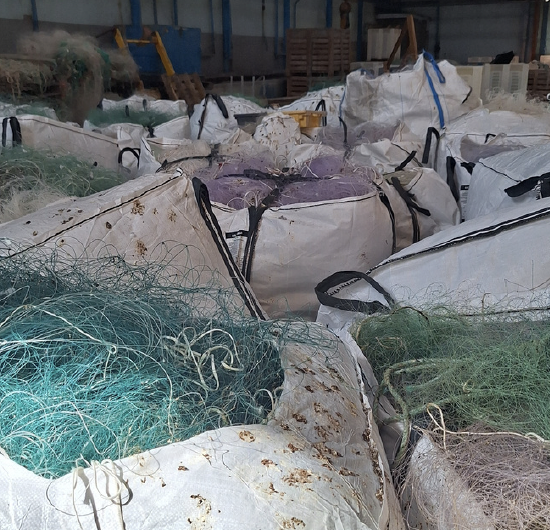
• Storage space in a closed shed for used nylon nets stored in 1m3 big bags and a 30m3 CIW skip
• Forklift for transporting nets for all fishermen with a certificate of ability to drive this type of vehicle.
Filet Recyclage collects used nets, which are then sorted, packaged and sent for granulation to companies, mainly in Europe. These pellets are used to make nylon objects.
• Fishermen put their used fishing nets directly into the big bags (no dedicated staff).
• The nets are collected by the company Filet Recyclage for recycling 3 times a year.
• The fish market manager is responsible for waste management.
Management costs: 562€ (2023) Quantity: 13.83T (2023)
Fishermen bring the litter they collect while fishing back to the port.
Disposal in a CIW skip without quantification or qualification.
• The port is responsible for purchasing the big bags, which represents a high cost.
• Loading the lorry carrying the big bags of nets takes a long time (1/2 day).
• It is sometimes difficult to raise awareness among fishermen about sorting their nets.
• Combating illegal dumping with enclosed areas and cameras.
• A long tradition of assembling and dismantling of nylon nets by fishermen in an enclosed, sheltered and easily accessible warehouse.
• Free access to a forklift to transport the nets from the docks to the warehouse.
• Monitoring of the quantities of nets collected in a file shared with the CCI.
Objectives:
Obtain the Clean Harbours Label: construction work to relocate the careening area and redevelop the space in front of the waste collection centre.
Fishing port, marina & ship repair area Presence of a fish market
Flotilla of 98 vessels (mostly deep-sea)

Multiple port activities, highlighting liquid and solid bulk traffic, as well as general cargo. Fishing is the main pillar of the port and has a fish market.
Fishing practice: 94 vessels (mostly small-scale), but the number rises to 190 when including boats that unload at the fish market but are not based at the port.
Landings: Poor cod, horse mackerel, mackerel, sardine, common bream, European anchovy, starling, hake, whiting, sole, megrim, skate, dogfish, black scorpionfish, monkfish, John Dory, red mullet, rockling, pollock, pipefish…
Fishing port and marina
Presence of a fish market
Flotilla of 95 fishing vessels (trawlers, trollers, pot vessels gillnetter)

This is small fishing pier with 19 regular boats from 6m to 28m, including 1 x Demersal trawler (Prawns), 2 x Pelagic vessels and Inshore fishing boats.
There is also a RNLI station and a Rowing Club attached to the pier.
A busy fishing harbour, home to a sailing club food shop/ smoke house, seafood shop, adventure facility, sailing club, coast guard, tour operators, boat yard, RNLI Lifeboat, net mending facility and a BIM ice plant.
Fishing practice: 12 regular boats under 24m,
Mostly bottom trawls, 1 x beamer trawl, 2 x pure seines Landings: White fish – Hake, Haddock, Whiting
Fishing port
A fish market (1st auction in Normandy and 6th in France) Fleet of 61 vessels (mainly trawlers)
General cargo, bulk solids, ship service, fishing activity (fresh and frozen), fish market.
Fishing practice: fleet of 359 vessels and ships (mostly artisanal vessels)
Landings: Black monkfish, White monkfish, Blue shark, Swordfish, Northern megrim, Atlantic pomfret, European hake, Korean flounder, Common squid, Horse mackerel…
Fishing port, commercial port and marina. Presence of a fish market Flotilla of 55 fishing vessels :
mainly dredgers & caseyeur (pot vessels)
Fishing activity and fish market.
Fishing practice: fleet of 144 vessels and ships (mostly small-scale fishing vessels)