


Fishing port of Ribeira
Fishing activity and fish market.
Fishing practice: fleet of 237 vessels and ships (mostly small-scale fishing vessels)

Fishing port, commercial port and marina Presence of a fish market
Flotilla of 40 fishing vessels (mainly coastal fishing) 1500 deep-sea trawlers landing fish every year.
![]()
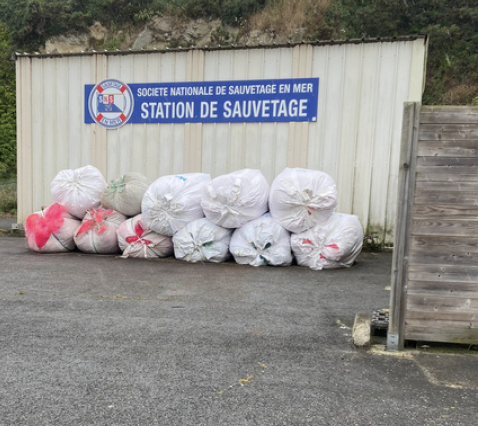
• Outdoor waste collection centre:
o 1 skip of 20m3 : used trawls and pots
o Small crates: EOLFG fine nets collected
o 1m3 Big Bags: sorted fine nets
• A non-closed storage area dedicated to EOLFG
• An area dedicated to sorted nets
• Recycling of PA nets by Fil&Fab for tonnages of around 30T per year (3T/load)
• Before, they had a contract with Filet Recyclage, which sent the nets to Spain (10T/load)
• Local reuse initiatives: Collected by recreational fishermen for reuse in their fishing activities
• 20m3 skip sent to landfill by Guyot Environnement
• Big bags with nets sorted by one employee
(26h/week) sent to Fil&Fab by Guyot Environnement for recycling
Management cost: 225€/T (2023) & 140€/T (2022)
Quantity: 135T (2023) & 162T (2022)
![]()
Fishermen bring the litter they collect while fishing back to the port. One staff member then collects it and places it in the appropriate skip for processing.
No data and no quantification or characterisation of this waste stream. It’s the fishermen’s responsibility to weigh it and report the data.
![]()
• No recycling channels sufficiently developed, particularly for used pots and trawls.
• A large number of tyres are collected, representing a very expensive stream for processing (€500/T).
• Sorting & dismantling of EOLFGs carried out by one employee hired by the CCI at a dedicated treatment site with an elevated platform.
• Handling of potential net mending waste by an agent who operates a blower.
• Voluntary approach to EOLFG management.
• Cleaning of the port basin once a year by a professional diver.
• Objectives:
o Provide a recycling channel for used trawls and pots.
o Reduce the number of illegal waste dumping with the introduction of fines by the harbour master’s office.

Fishing activity and fish market.
Fishing practice: fleet of 237 vessels and ships (mostly small-scale fishing vessels)

Fishing, seafood processing and sales.
Marine leisure cruises, sailing club, tourism.
Fishing practice: There are currently 5 pelagic trawlers, 36 demersal trawlers and 12 crabbers.
Landings: Prawn, Crab and white fish

Fishing port, marina & ship repair area Presence of a fish market
Flotilla of 98 vessels (mostly deep-sea)

This is small fishing pier with 19 regular boats from 6m to 28m, including 1 x Demersal trawler (Prawns), 2 x Pelagic vessels and Inshore fishing boats.
There is also a RNLI station and a Rowing Club attached to the pier.

Fishing port and marina
Presence of a fish market
Flotilla of 95 fishing vessels (trawlers, trollers, pot vessels gillnetter)

Commercial, nautical-sport, tourism, fishing, and shipyard activities, fish market.
Fishing practice: for WIF, three trawlers from the Mares Circulares project (with lengths ranging from 28 to 36 meters) are collaborating
Landings: Atlantic mackerel, European anchovy, and Atlantic bonito

General cargo, bulk solids, ship service, fishing activity (fresh and frozen), fish market.
Fishing practice: fleet of 359 vessels and ships (mostly artisanal vessels)
Landings: Black monkfish, White monkfish, Blue shark, Swordfish, Northern megrim, Atlantic pomfret, European hake, Korean flounder, Common squid, Horse mackerel…

Fishing port
A fish market (1st auction in Normandy and 6th in France) Fleet of 61 vessels (mainly trawlers)

Fishing port and marina
No fish market but fish preparation area 7 fixed vessels (small-scale coastal fishing)