
Fishing port of Vigo

Date of visit: 07/11/2024
General information
Port authority: AP Vigo
Administrator: Ports of the State
Port description:

General cargo, bulk solids, ship service, fishing activity (fresh and frozen), fish market.
Fishing practice: fleet of 359 vessels and ships (mostly artisanal vessels)
Landings: Black monkfish, White monkfish, Blue shark, Swordfish, Northern megrim, Atlantic pomfret, European hake, Korean flounder, Common squid, Horse mackerel…

Management of used fishing gear

Equipment
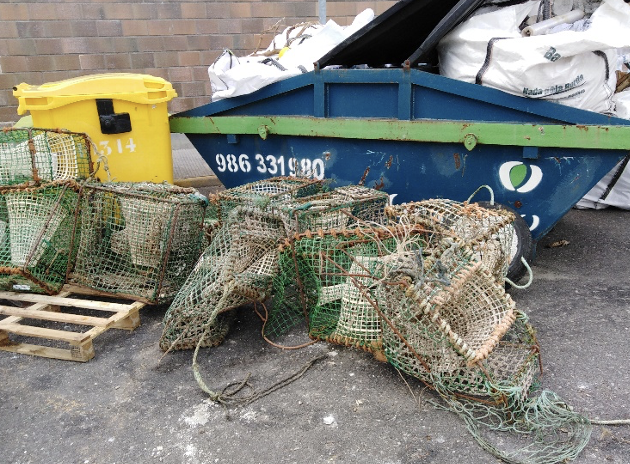
  • 1 container for the recovery of EOLFG and 1 for WIF.
  • Two designated, covered areas within the Port Authority.
  • Forklift or truck-mounted crane, with easy access for the transport and handling of the nets.
Management
  • The nets are accumulated in a specific 5 m³ container at the port.
  • The crew unloads the EOLFG, and the nets are stored in two exclusive covered areas managed by the Port Authority, depending on whether they belong to large-scale or small-scale fishing gear.
  • The net makers are responsible for repairing the nets; however, a system for their collection and subsequent management at the port facilities has not been implemented.
  • Once the container is full, the EOLFG are transported to a dedicated facility outside the port.
  • The Commercial Management Area, within the Environmental Division, oversees communication within the port regarding waste management, which includes both fishing by-products and the contract for cleaning the Fishing Port.
Reuse
  • The WIF are accumulated in 1 m³ bags on the boats.
  • Upon arrival at the port, fishermen manually unload the WIF big bags and deposited in a specific container. Larger vessels request the removal of this type of waste directly through one of the service providers, which will notify the Port Authority of Vigo (APVIGO).
  • Characterisation of the waste is carried out at the treatment plant, while quantification is performed globally by waste type.
  • A total of 98.3 m3 of passive fishing litter were recorded in 2023.
  • Quantity: 10,000 €/year
Passive fishing for litter

Current pratices
  • The port is involved in ‘Fishing for Litter (FfL)’ projects in collaboration with fishing fleets and projects staff
  • The PFW are accumulated in 1m³ bags on the boats.
  • Upon arrival at the port, fishermen manually unload the PFW big bags and deposited them in a specific container. Larger vessels request the removal of this type of waste directly through one of the port service providers, which will notify the Port Authority of Vigo (APVIGO).
  • Characterisation of the waste is carried out at the treatment plant, while quantification is performed globally by waste type.
  • A total of 98.3m3 of PFW were recorded in 2023.
Constraints and bests practices

Constraints
  • Increased awareness and further research are required for effective valorisation.
  • There is a demand for the establishment of a new green point and the expansion of valorisation activities.
  • Data collection remains complex and fragmented.
  • Budget limitations present a significant constraint.
Bests practices et objectives
  • In addition to the provisions established in the MARPOL Convention, the port is equipped with a Clean Point, Green Point, and the option to leave waste on board at the dockside.
  • The flow of information and communication is efficiently managed through email, telephone, and in-person interactions.

Objectives

  • They seek to increase the number of awareness and training campaigns.
Other technical data sheets
Filters
Reset
information sheet

Fishing port of Marìn

General cargo (paper, wood, fruit, steel), bulk solids (grains, flours, and fertilizers), ship services (construction, repair, fuel, oils…), fishing activity (fresh and frozen), fish auction.
Fishing practice: 77 vessels and ships (mainly inshore, 12 trawlers operating in the Grand Sole fishing grounds, 4 coastal trawlers, and 8 operating in Portuguese waters)
Landings: Sardine, horse mackerel, Atlantic mackerel, Atlantic bonito, spider crab, velvet crab, shrimp, Norway lobster, hake, European hake (whiting), blue whiting, squid, monkfish, scorpionfish, red gurnard, sole, cuttlefish, octopus, conger eel, ray, others

Read more
information sheet

Fishing port of Audierne

Fishing port and marina
Presence of a fish market, online sales only Flotilla of 30 vessels (gillnetter and trollers)

Read more
information sheet

Fishing port of Union Hall

This is small fishing pier with 19 regular boats from 6m to 28m, including 1 x Demersal trawler (Prawns), 2 x Pelagic vessels and Inshore fishing boats.
There is also a RNLI station and a Rowing Club attached to the pier.

Read more
information sheet

Fishing port of Gijón

Commercial, nautical-sport, tourism, fishing, and shipyard activities, fish market.
Fishing practice: for WIF, three trawlers from the Mares Circulares project (with lengths ranging from 28 to 36 meters) are collaborating
Landings: Atlantic mackerel, European anchovy, and Atlantic bonito

Read more
information sheet

Fishing port of Camaret

Fishing port and marina
No fish market but fish preparation area 7 fixed vessels (small-scale coastal fishing)

Read more
information sheet

Fishing port of A Coruña

Multiple port activities, highlighting liquid and solid bulk traffic, as well as general cargo. Fishing is the main pillar of the port and has a fish market.
Fishing practice: 94 vessels (mostly small-scale), but the number rises to 190 when including boats that unload at the fish market but are not based at the port.
Landings: Poor cod, horse mackerel, mackerel, sardine, common bream, European anchovy, starling, hake, whiting, sole, megrim, skate, dogfish, black scorpionfish, monkfish, John Dory, red mullet, rockling, pollock, pipefish…

Read more
information sheet

Fishing port of Granville

Fishing port, commercial port and marina. Presence of a fish market Flotilla of 55 fishing vessels :
mainly dredgers & caseyeur (pot vessels)

Read more