
information sheet

Fishing Port of Bueu
Fishing activity and fish market.
Fishing practice: fleet of 144 vessels and ships (mostly small-scale fishing vessels)

Fishing port, marina & ship repair area Presence of a fish market
Flotilla of 98 vessels (mostly deep-sea)

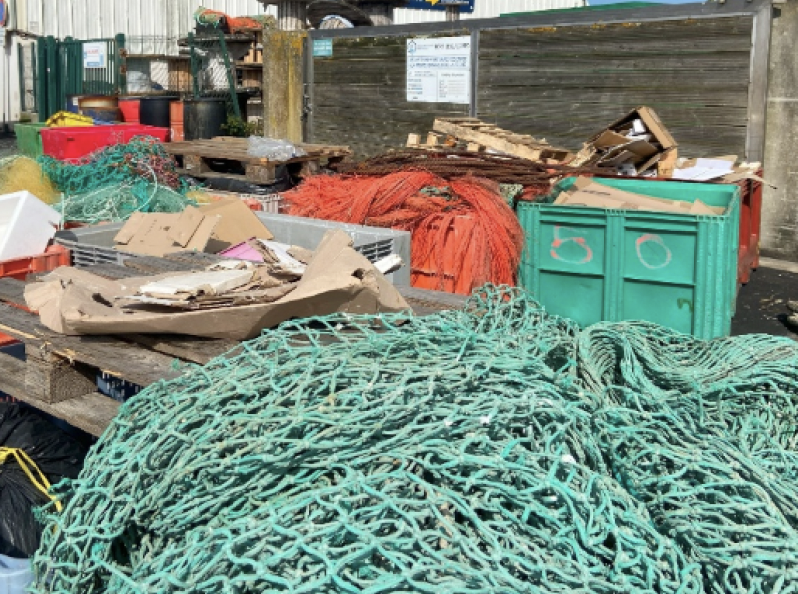
• Closed port waste collection centre: a 30m3 skip for EOLFG (mainly trawlers)
• Bins on the docks for fishermen to put all their waste in when they disembark
• Storage space for used trawls that are not dismantled
• FILIPECHE project (2021-2022) recycling of trawls from Cornouaille ports, with a lorry sent to a trawl recycling facility in Denmark (Plastix)
• Local reuse initiatives: Recreational fishermen’s reuse of trawls in the storage area for their fishing activities
No existing recycling chain in France yet but large quantities of trawl nets.
• When the bins on the docks are full, two employees hired by the CCI collect the bins and carry out an overall sorting according to the flows (wood, EOLFG, CIW, etc.).
• The EOLFG are placed in the skip and Guyot Environnement transports it to the landfill site
Funding: included in the REPP (fishing port equipment fee) Management costs: 160€/T (2023)
Quantity: 92.2T of trawls (2023)
No existing practices. This type of waste is returned but not characterised or monitored in terms of volume.
REPECHONS LES OCEANS – The port has been contacted by the Ecoalf foundation’s Repêchons les océans programme to install bins in some ports in Cornouailles to collect passively fished waste. The operation has not yet produced conclusive results
• Nets are not recycled due to low volume.
• Illegal dumping on the docks, particularly at weekends, still too frequent despite the introduction of fines.
• Rope cuttings left on the docks, even though they are occasionally cleaned with a blower.
• 2 to 3 times a year, a diver cleans the harbour water (recovery of fishing gear).
• Cleaning of port docks 2 to 3 times a year (collection of bits of plastic, polystyrene, etc. in the port)
• Objectives:
o To be part of a project with a medium/long-term approach to find sustainable, long-term value chain for used trawlnets.
Fishing activity and fish market.
Fishing practice: fleet of 144 vessels and ships (mostly small-scale fishing vessels)
General cargo, bulk solids, ship service, fishing activity (fresh and frozen), fish market.
Fishing practice: fleet of 359 vessels and ships (mostly artisanal vessels)
Landings: Black monkfish, White monkfish, Blue shark, Swordfish, Northern megrim, Atlantic pomfret, European hake, Korean flounder, Common squid, Horse mackerel…
Multiple port activities, highlighting liquid and solid bulk traffic, as well as general cargo. Fishing is the main pillar of the port and has a fish market.
Fishing practice: 94 vessels (mostly small-scale), but the number rises to 190 when including boats that unload at the fish market but are not based at the port.
Landings: Poor cod, horse mackerel, mackerel, sardine, common bream, European anchovy, starling, hake, whiting, sole, megrim, skate, dogfish, black scorpionfish, monkfish, John Dory, red mullet, rockling, pollock, pipefish…

This is small fishing pier with 19 regular boats from 6m to 28m, including 1 x Demersal trawler (Prawns), 2 x Pelagic vessels and Inshore fishing boats.
There is also a RNLI station and a Rowing Club attached to the pier.
Commercial, nautical-sport, tourism, fishing, and shipyard activities, fish market.
Fishing practice: for WIF, three trawlers from the Mares Circulares project (with lengths ranging from 28 to 36 meters) are collaborating
Landings: Atlantic mackerel, European anchovy, and Atlantic bonito
Fishing, seafood processing and sales.
Marine leisure cruises, sailing club, tourism.
Fishing practice: There are currently 5 pelagic trawlers, 36 demersal trawlers and 12 crabbers.
Landings: Prawn, Crab and white fish
Fishing port and marina
Presence of a fish market
Flotilla of 95 fishing vessels (trawlers, trollers, pot vessels gillnetter)
Fishing port
A fish market (1st auction in Normandy and 6th in France) Fleet of 61 vessels (mainly trawlers)
Fishing activity and fish market.
Fishing practice: fleet of 237 vessels and ships (mostly small-scale fishing vessels)