
Welcome
to the website dedicated to preventing waste in fishing ports on the Atlantic coast
As part of the Free-LitterAT project, several European partners (France, Spain, Portugal, Ireland) are working together to tackle marine litter. One of the key priorities is to reduce waste from used fishing gear and waste passively fished by encouraging its collection, treatment and recycling.
Find out more about current practices in fishing ports on the Atlantic coast and the solutions that can be implemented to limit the impact of this waste on the oceans.
Recycling
of used fishing gears
nets, trawls, traps, dredges, lines, seines, etc.
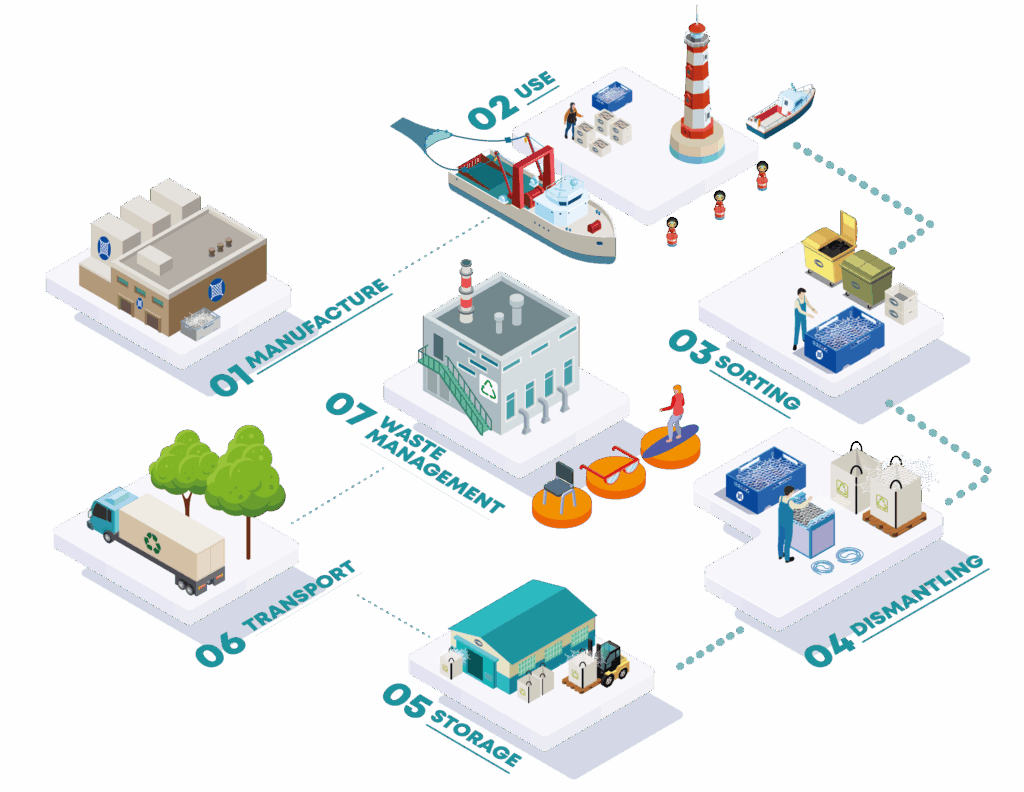
1. MANUFACTURING
• Fishing gear producers: manufactures, sells or imports fishing gear
2. USE
• Fishermen (“sailors” or “skippers”) who work on trawlers, gillnetters, line boats, pot boats…
3. SORTING
• Fishermen
• Port agents
4. DISMANTLING
• Companies specialising in the assembly and dismantling of fishing nets
• Fishermen
• Retired fishermen
• Adapted employment services
5. STORAGE
Storage facilities provided by the port manager:
• On the quayside
• In a port reception facility
• In a dedicated warehouse
6. TRANSPORT
• By the port agents themselves
• By a transport service provider
7. WASTE MANAGEMENT
• Recycling: mechanical or chemical recycling and manufacture of new objects from used fishing gear.
• Other types of waste management: Incineration, Landfill, Energy recovery.
Today, the majority of used fishing gear ends up in landfill.
• Other existing practices: Repair, reuse, repurposing, etc.

Create zero-waste coastal communities by combining knowledge,
tools and technologies with pilot actions involving the participation of multiple stakeholders.


Fishing port sheets
information sheet
Fishing port of Marìn
General cargo (paper, wood, fruit, steel), bulk solids (grains, flours, and fertilizers), ship services (construction, repair, fuel, oils…), fishing activity (fresh and frozen), fish auction.
Fishing practice: 77 vessels and ships (mainly inshore, 12 trawlers operating in the Grand Sole fishing grounds, 4 coastal trawlers, and 8 operating in Portuguese waters)
Landings: Sardine, horse mackerel, Atlantic mackerel, Atlantic bonito, spider crab, velvet crab, shrimp, Norway lobster, hake, European hake (whiting), blue whiting, squid, monkfish, scorpionfish, red gurnard, sole, cuttlefish, octopus, conger eel, ray, others
information sheet
Fishing port of Gijón
Commercial, nautical-sport, tourism, fishing, and shipyard activities, fish market.
Fishing practice: for WIF, three trawlers from the Mares Circulares project (with lengths ranging from 28 to 36 meters) are collaborating
Landings: Atlantic mackerel, European anchovy, and Atlantic bonito
information sheet
Fishing Port of Bueu
Fishing activity and fish market.
Fishing practice: fleet of 144 vessels and ships (mostly small-scale fishing vessels)
information sheet
Fishing port of Camaret
Fishing port and marina
No fish market but fish preparation area 7 fixed vessels (small-scale coastal fishing)
initiatives
initiative(s)
FILIPECH
The FILIPECH project has taken two main actions: the establishment of the producer responsability organisation dedicated to the management of end-of-life fishing gear, and the carrying out of new experiments in four ports to test and improve the collection and recovery of used HDPE trawls
Read more